Welcome to my first Study Notes post!
This is a series where I will spend two weeks researching a topic for my next project.
Each study notes post will include interesting facts about Japan in the Edo period (1603-1868) AND clues about my next project.
So what is the Edo Period?
The Edo period began with the formation of a new type of government. The bakufu ruled by a shogun. Thus it only seems appropriate that I begin my study of the Edo period by understanding the government system of the era.
I promise it’s WAY LESS boring than it sounds.
While the Mayflower pilgrims were planning their voyage to the New World, Japan was entering a new political world of their own. They call it the Edo Period (1603-1868).
I think of it as the Renaissance Period of Japan. There was lots of religion, and art, and bureaucracy.
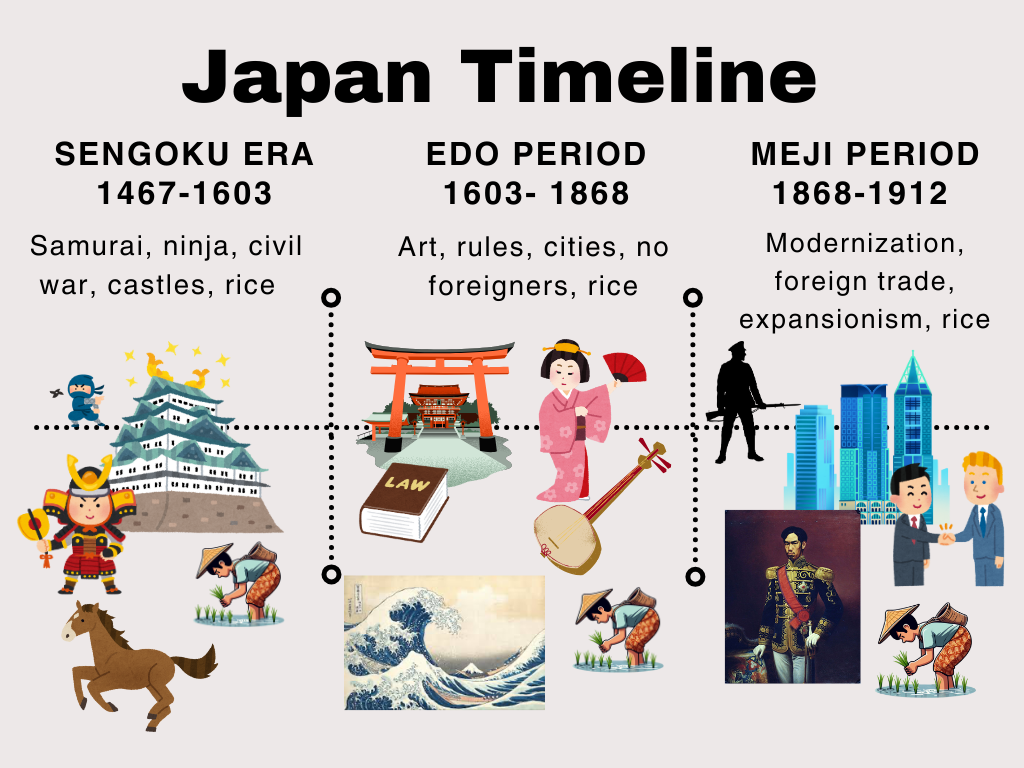
Here’s a timeline I made. . .
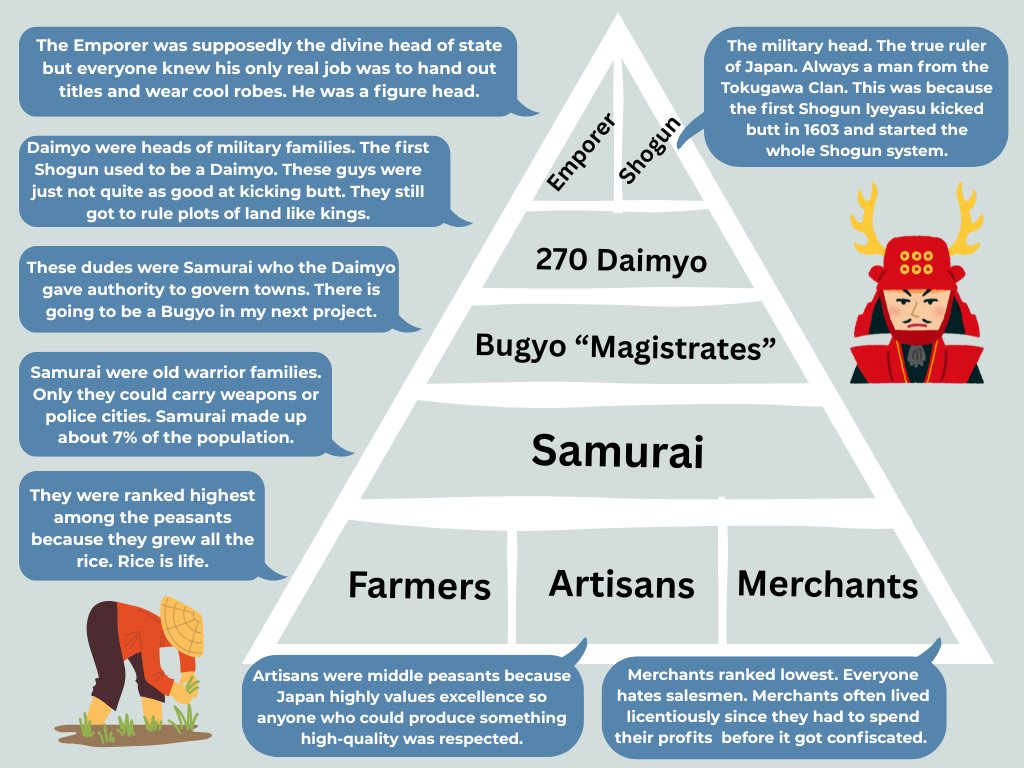
So basically the government was like this . . .
The Emporer – The Tokugawa Shogun
The Emporer was supposedly the divine head of state but everyone knew his only real job was to hand out titles and wear cool robes. He was a figure head.
The Shogun was the military head. He was the true ruler of Japan. He was always a man and always from the Tokugawa Clan. This was because Mr Iyeyasu Tokugawa kicked butt in 1603 and started the whole Shogun system.
270 Daimyo
These were the heads of military families. Mr Iyeyasu used to be a Daimyo too. These guys were just not quite as good at kicking butt in 1603. They still made out pretty good though since they got to rule plots of land like they had before 1603.
Bugyo “Magistrates”
Yeah these dudes were Samurai who the Daimyo gave authority to rule their towns for them. There is going to be a Bugyo in my next project.
Samurai
These were the warrior families from the Sengoku period pre-1603. They were the only ones allowed to carry weapons or police cities. Samurai made up about 7% of the population.
Farmers
They were ranked highest among the peasants because they grew all the rice. Rice is life.
Artisans
These guys were the middle peasants because Japan places a high value on excellence so anyone who could produce something high-quality was respected.
Merchants
These folks ranked lowest. I’m not sure why. Maybe because they often traveled and so they had no established roots. Or maybe because they were in the marketing business and everyone bullies salesmen. e.x. When merchants became too wealthy the government would just look for something to accuse them of to justify taking their stuff. Man. That must’ve been so disappointing.
Here! I made another graphic.
Here are five other fun facts I learned. (Not sure if they’ll make it into the story…)
- Daimyo were obligated to live in castles. This was partially meant to drain their resources so they wouldn’t easily be able to organize a rebellion against the Shogun.
- Edo, the capitol city, was the largest city in the world at that time!!
- The Shogun ordered all the peasants to turn in their weapons which were melted down to create a GIANT Buddha statue!
- Christianity was outlawed in 1637 after some rebels in the Nagasaki area used catholic symbols on their rebel flags. To this day, Japan is one of the least Christian countries on earth.
- When Tokugawa shogun first came to power he relocated all the Daimyo to disorient them and prevent rebellion. He put the more loyal Daimyo closer to Edo and the less loyal Daimyo far north and south.
- MY FAVORITE FACT: If a Daimyo wanted to shirk a duty the Shogun asked of him he would often claim to have “an illness” which prevented him from complying. I just love the picture of proud Japanese warlords sending the same message that introverts use today to get out of something. “Sorry. I’m feeling sick, I can’t.” Adorable.
Well, that’s all the fact I’ve got for you today. Try out that comment section and let me know if you learned anything! And check out my Work In Progress page if you want to learn more about the book this research is for!
Not bureaucratically,
Kasumi Sonoda