Pro Tip: If you time travel to Edo period Japan don’t bring any dolls that are too big. Also don’t bring any dolls wearing clothing with thick stripes. You could be arrested for that. I am not joking. Don’t do it.
Well. Now that’s out of the way.
Welcome to my Study Notes!
I’ve been researching for my next novel. I write current updates and study notes on my newsletter, and here on my website I post the old research notes. I hope you have a good time here, learn something, and maybe notice the clues I sprinkle in here about my upcoming novel!
What were some of the ridiculous rules of the Edo Period?
This was supposed to be the funny post of the series, but it got weirdly existential. You’ll see.
Behold. Legislative madness:
- Peasants must dress like peasants. Even if you got filthy rich, you still had to look poor. Brown, gray, or blue. No fancy fabrics, patterns, or ornaments. It was cosplay poverty . . . or jail!
- Commoners may not own weapons. Too predictable to be funny tbh
- Daimyo (lords) must live in Edo every other year. Their wives and kids had to stay there full-time. (It’s giving “hostage” vibes.)
- Westerners were forbidden in Japan. Except the Dutch. Only at Dejima port. And only for trade. (Context: They were afraid Christian influence would spark rebellion.)
- If you left Japan, you could never return. Even if you just got washed out too far by a storm. They were really serious about this one.
- Peasants need permission to travel. They also had to use specific inns and submit to interrogations at checkpoints. TSA, is that that you?
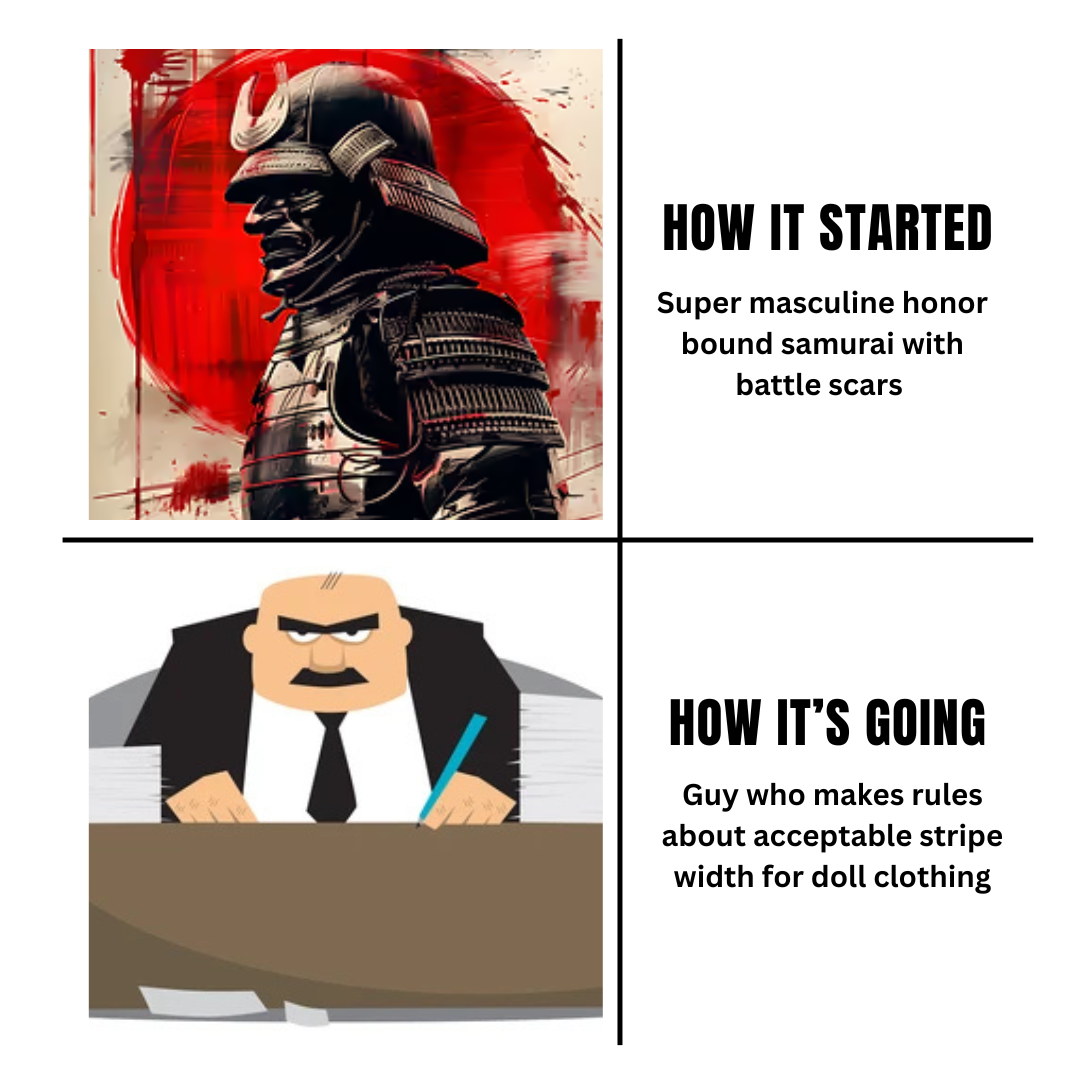
- Samurai couldn’t work jobs. That would be beneath them. Instead, the government gave them a stipend that did not grow with the cost of living.
- Lewd behavior must stay in the pleasure districts. This was where the geisha, and actors, and dancers, and pr***itutes lived. “If you’re gonna sin, sin over there.” —actual quote from the Shogun (probably)
Funny? Sure. But how did it even get to this point? This is absurd.
How did it even get to this point?
Well . . . I imagine the 150 years of nonstop civil war had a great impact on the following era. Think about the psychological effect that five generations of nothing but chaos and loss would have on a culture.
Confucianism, (acceptance of fate, social hierarchy, and the collective good over the individual) was the reigning philosophy of the warring states period. I’m sure people wanted peace but since it sat so far from reach, they likely began to wonder if peace was even real. Instead of peace they settled for honor—and fought to the death over it.
On top of the existential dread, there was the inescapable reality of grief and fear and anger and constant change. That leaves its own psychological mark on a nation. You and your parents and their parents and their parents and their parents all grew up knowing that if you didn’t act right, you’d likely lose your life. But also, if you did act right, you might still lose your life. Not to mention that families were all missing members who had died in battle or been captured, never to be heard from again. And for the families that were whole, they had to watch daddy suffer from the things he had seen, all the while wondering how long before tragedy came for them too.
Then suddenly, after a bloody climactic race for the top, one man sits down on the dais of power and the world goes quiet. It’s over.
Except it isn’t.
Trauma has become so ubiquitous that it feels normal, and now the only thing that ever stayed constant (war) is gone. Peasant foot soldiers are turned out to work the fields and shops. Samurai are told to “Sit. Stay.” And the many Daimyo who used to command thousands are now the ones being ordered around by a shogun who is paranoid (rightfully so) they would stab him in the back.
This is the population that must now rewrite what it means to be Japanese. After barely catching their breath, the scramble begins as people grab at wealth and power in an attempt to fill their gaping emotional wounds with peace and security. The market, government, lifestyle, and spirit of the age are all morphing as people grasp for that peace they never had.
And they aren’t afraid to kill to get it.
“Laws! Laws will fix it,” thought every government ever. But hey. You can’t be too hard on them. They were grasping for that same peace as everyone else.
You see what I mean? This post just didn’t turn out as “silly haha” as I intended.
The Takeaway
Those laws are ridiculous, sure, but the undercurrent struck me hard: Control is a misguided attempt to find peace.
How human.
Healing is hard. Control feels easier.
I could write a whole book about this and the art and ideologies that grew out of the Edo period but . . . oh, wait. I am writing a book about that! *high-fives herself*
Peace out,
Kasumi
P.S. Here! Have a meme I made.