

Let’s be honest.
We’ve all stolen things.
Maybe it went well.
It probably didn’t.
For example: One time I stole a frozen raspberry. One. One raspberry. The heist went flawlessly, but then I felt so guilty, I went and confessed it to my parents, who were terribly confused as to why I sat them down for a such a serious discussion when the crime was so, well . . . one raspberry.
Anyway, I’d like to conduct a more impressive heist in my upcoming book. (Code Name: Project “Sparkle Cup”) So I’ve been studying the heist subgenre.
I watched a few heist movies and read the SparkNotes on a LOT more, but the most helpful and enthralling resource I found was Charles Kunken’s Story Grid on heist movies.
If you want to level up your nerd score, you can check out Kunken’s website. Otherwise, see the chart I stole from him. *wink*
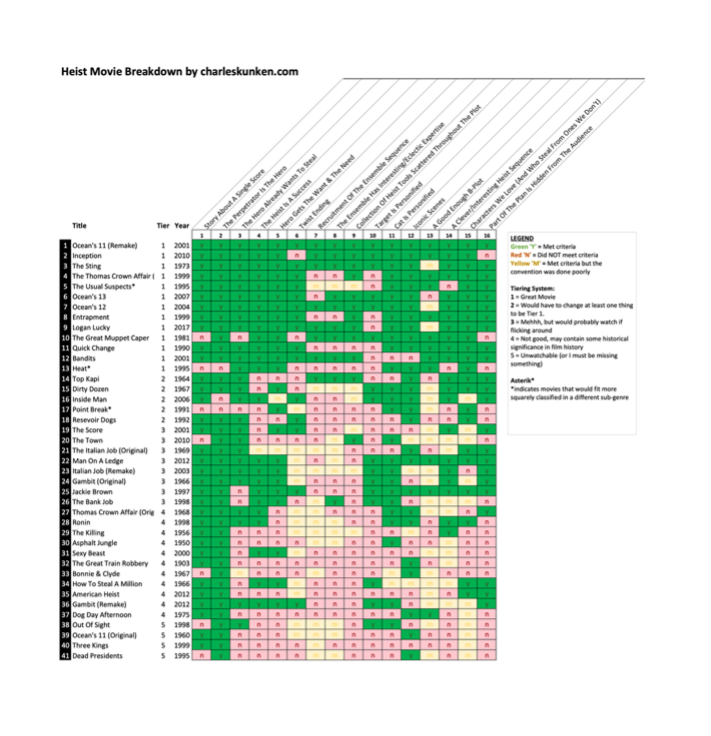
I’m going to try to implement all these criteria in Project Sparkle Cup except for #3: “Hero already wants to steal.” Typically, you shouldn’t waste time showing how the main character evolves from uninterested civilian to determined criminal. It’s better for the pacing if you start the story with her already locked in on the prize. But these principles were taken from a study of film not print. A 100,000 word novel should have more wiggle room than in a 120 minute movie.
I know what you are thinking.
“Kasumi, you couldn’t even steal one raspberry without folding. Do you really think you are cut out for a heist author’s degenerate life?”
I see your point, but after studying the genre, I’d argue that the real power and appeal of heists are actually quite philosophical and provide the perfect setting for Project Sparkle Cup’s themes and character arcs!
At it’s heart, Project Sparkle Cup is a story about learning to trust after someone you love abandons you. #trustissues
3 Benefits of Stealing (for Project Sparkle Cup) . . .
1. Heists acknowledge that the world isn’t black and white.
This subgenre is built on the subversion of good-guy/bad-guy stereotypes. Sometimes thieves are better men than CEOs. Sometimes rules don’t have our best interest in mind. And sometimes the system we were raised to worship is just well-branded corruption.
This is the perfect backdrop for our POV character’s trust development arc.
You see. . .
One of the most painful things about betrayal is how it robs us of our black-and-white worldview. It becomes hard to trust our own judgements of safe and unsafe. After all, we were wrong once. This throws us headfirst into a hurricane of fear, anger, and confusion. Deep down, I think it’s grief for our worldview.
What do you do with grief? The first step is to acknowledge the reality of the loss and betrayal.
It happened.
It shouldn’t have, but it did. And it was wrong. And it really hurts.
The heist genre’s honesty about moral complexity fittingly frames our MC’s inner journey toward trusting again. A trust built on a new worldview that doesn’t ignore or inflate the wrong but factors it in accurately.
2. Heists require close relationships
The classic heist plot starts with the assembly of a team of people who are very different yet must work closely and depend on each other to reach a common goal.
Now what is the thing people with trust issues struggle with? I’ll give you one guess.
That’s right. Trusting people.
How can you ever trust again after you’ve seen the ugly side of this world?
I’ll tell you a secret.
Two things can be true at the same time. Bad exists, yes. But good exists too.
To heal, you must hold both truths at the same time. That means you’ve got to stop holding everyone at arms-length.
Get good at boundaries not isolation.
You want to know another secret? Healing only happens in community where you can:
- Test new truths
- Practice healthy habits
- Rewire your nervous system through repeatable good results
It’s scary, but as you step into your own empowerment and build relationships with healthy people, that trust you lost can grow back. Better yet, it isn’t a blind naïve trust anymore. It’s an informed secure trust focused on connection and honesty.
The teamwork element of the classic heist is exactly the medicine our MC needs in her journey to heal and to trust again.
3. Heists are flashy. Just like Edo.
Then there is the aesthetic side of this plot. The best heists need:
- Gadgets
- Costumes
- Secrets
- Big personalities
- Lavish settings
If you’ve read the other Study Notes emails, you know that Edo period Japan has it all. I can’t wait to weave together:
- The rustle of silk hems over wood floors
- The gurgle of tea falling into poisoned cups
- Savory smoke haunting market street long after sundown
- The laughter of businessmen playing God behind paper doors
- The anxious scratching of a pen full of secrets clutched in a girl’s hand
- Yellow candle-light reflected on a tear streaked cheek
- The distant hoot of monkeys echoing through the swirling steam of a mountain hot-spring
- Bare feet thumping over rooftops
- The friction of white paint on young skin
- A melody hummed in the dead of night
Edo era Japan is full of color and every manner of distraction. It’s a playground for magicians and thieves looking to pull a sleight of hand. It’s also an easy place for a distrusting child to find a mask. But if she and her newfound family are going to pull of this heist, she is going to have to take the mask off. Check out the page on Project Sparkle Cup if you want to read more about the plot.
Before you go, help me out in the comments. Do you:
- Have any wisdom or tips for healing trust issues?
- Have any good heist stories from books, films, or real life?
Yours,
Kasumi Sonoda